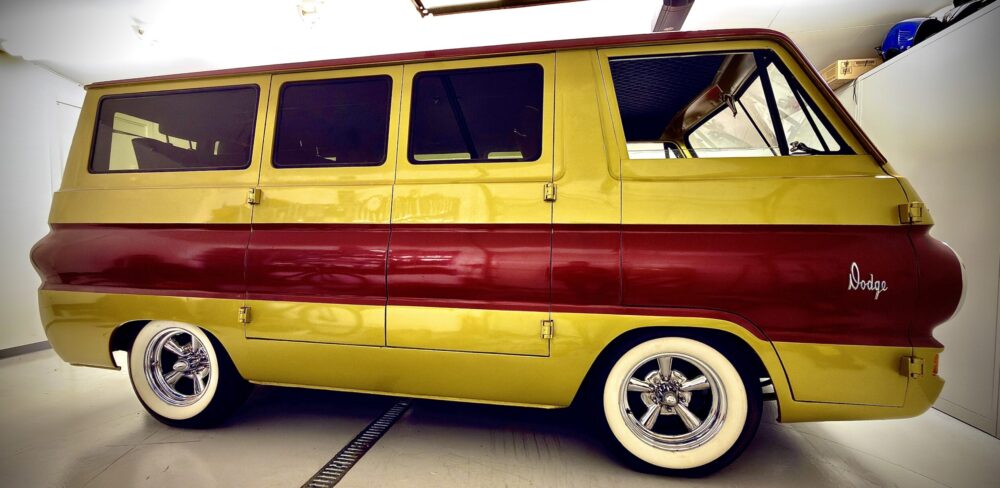
The History of the Dodge A100 (1964–1970)
The Dodge A100 was a line of compact trucks and vans introduced by Chrysler Corporation to compete with the established Volkswagen Type 2, the Ford Econoline, and the Chevrolet Corvair 95/Greenbrier. It was a radical departure from traditional American truck design, prioritizing interior volume and maneuverability.
1. Design Philosophy: ”Forward Control”
The defining characteristic of the A100 was its cab-over (Forward Control) design. By placing the driver and passenger directly over the front axle, Dodge managed to maximize cargo space while keeping the vehicle’s overall footprint remarkably small.
- Engine Placement: The engine sat in a ”doghouse” (an insulated cover) located between the front seats.
- The Unibody: Unlike larger trucks of the era, the A100 utilized a unibody construction, making it lighter and more rigid.
2. Model Variants
The A100 series was highly versatile, serving three distinct markets:
- The Panel Van: A windowless workhorse used primarily by tradesmen and delivery services.
- The Sportsman Wagon: A passenger version with side windows and removable seating for up to eight people. It is often cited as a precursor to the modern minivan.
- The Pickup: A unique ”cab-forward” pickup truck. Because of its short 90-inch wheelbase and light rear end, these trucks were notoriously prone to ”nose-diving” under heavy braking when empty.
- The A108 (Long Wheelbase): In 1967, Dodge introduced the A108. It featured a 108-inch wheelbase, providing significantly more room, which made it the gold standard for camper conversions in the late 60s.
3. Performance: The First V8 Van
While competitors initially relied on small four- or six-cylinder engines, Dodge revolutionized the segment in 1965 by offering a V8 engine.
- Slant-6 Power: The 170 and 225 cubic-inch ”Slant-6” engines were legendary for their durability.
- V8 Dominance: The introduction of the 273 cu in (and later the 318 cu in) V8 turned the A100 into a high-performance machine compared to its rivals. It could haul heavier loads and maintain highway speeds with ease.
- Transmissions: Most models featured either a 3-speed manual (shifted on the steering column) or the dependable 3-speed TorqueFlite automatic, which used a unique dash-mounted shifter.
4. Pop Culture and Legend
The A100 secured its place in history through some iconic associations:
- The ”Little Red Wagon”: Built by Bill ”Maverick” Golden, this was the world’s first wheelstanding exhibition drag truck. With a 426 Hemi engine mounted in the truck bed, it could drive the entire quarter-mile on its rear wheels.
- The Hippie Movement: Alongside the VW Bus, the Dodge A100 Sportsman became a symbol of 1960s counterculture, often decorated with psychedelic murals.
- Film & TV: The A100 has appeared in numerous productions, most notably as Michael Kelso’s van in That ’70s Show.
5. Legacy
Production ended in 1970 to make way for the Dodge B-Series (the ”Tradesman”). The B-Series moved the engine slightly forward to create a ”short nose,” which improved safety and cabin ergonomics. Today, the A100—especially the pickup version—is a highly sought-after collector’s item due to its ”retro-futuristic” styling.